
Pivotal · USA
Helix
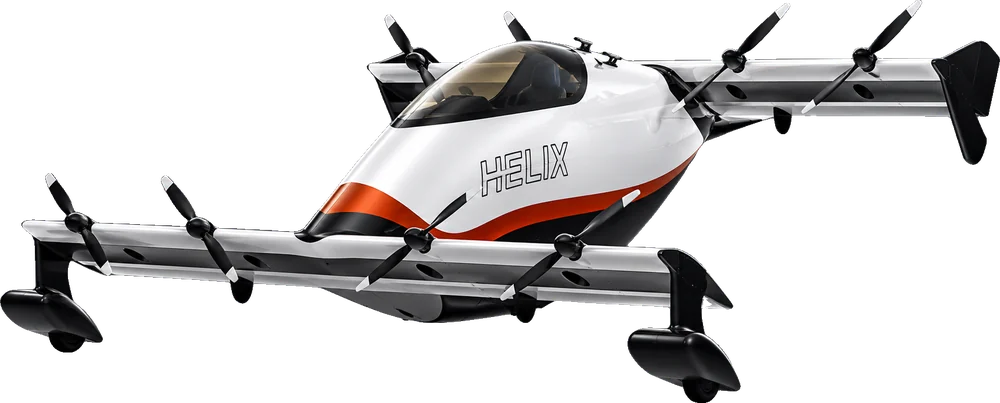
A single-seat personal aircraft that takes off sitting on its tail, then tips its whole body forward to fly on its wings. Pivotal sells it to fly without a pilot's licence.
Pivotal is taking refundable reservations for 2027 delivery positions.
How it works
6 ideas that make Helix different
Loading 3D model…
Front wing rotors
Four rotors on the front wing. Changing the balance between front and rear rotors pitches the whole aircraft from upright, for take-off, to level, for cruise.
Why it matters
To move, the computer speeds up the rotors on one side and slows those opposite. The aircraft tips towards the slower side, part of the rotors' push now points sideways, and it moves that way: forward, back or sideways.
Rear wing rotors
Four more rotors on the rear wing. For a vertical take-off, all eight push together while Helix sits upright.
Why it matters
To go up, the flight computer speeds up every motor at once, so the rotors push down more air than the aircraft weighs. To come down, it slows them all evenly. Hovering means holding the push exactly equal to the weight.
Tandem wings
Two wings, one behind the other, that carry Helix's weight once it has tipped forward, at a cruise of 102 km/h.
Why it matters
Holding an aircraft up with rotors alone uses a lot of energy. Once moving, a wing does that job far more cheaply, by deflecting the passing air downward, which is why winged eVTOLs can fly further and faster than pure multicopters.
Cockpit
A single seat. Pivotal's software handles take-off and landing automatically; the pilot steers in between.
Why it matters
The pilot never controls motors one by one. The controls tell the flight computer where to go, and it works out how fast each rotor must spin to get there while keeping the aircraft level.
Parachute
A whole-aircraft parachute built into Helix. In Pivotal's photo of it deployed, a single line runs up from the top of the fuselage, and the aircraft comes down level beneath the canopy.
Why it matters
A whole-aircraft parachute is the last line of defence. If the aircraft can no longer fly safely, the pilot fires it and it lowers aircraft and pilot to the ground together. It is meant for rare emergencies, not routine landings.
AI-generated 3D model
Drag to turn it, scroll or pinch to zoom, right-drag or two fingers to move. Tap a glowing part to see what it does.
It tips its whole body
Instead of tilting its rotors or wings, Helix rotates the entire carbon-fibre airframe: it rises sitting upright, then pitches forward until its tandem wings take the weight, steering by changing the speed of its fixed rotors.
Wings do the cruising
Once flying forward, the wings provide most of the lift, which uses far less energy than hovering on rotors alone. That is how it covers about 32 km in 20 minutes.
The computer handles the tricky parts
Take-off and landing are automated, the moments when tilting aircraft are hardest to fly. The pilot steers with a single stick in between.
Built to fail safely
Critical systems are triple-redundant, so one failure leaves two backups, and an aircraft parachute covers the rare case where that isn't enough.
Thriftier than an electric car
Pivotal puts the Helix's energy use at 245 Wh per mile, slightly less than the 270 Wh it quotes for an electric car. Flying on wings, with no roads or tyres to fight, its 8 kWh battery covers 20 miles.
No licence, by design
Helix weighs exactly 254 lb empty, the most a powered ultralight may weigh under US Part 103 rules. Staying at that limit is what lets Pivotal say buyers don't need a pilot's licence, in exchange for flying only over open country, away from airports.
Watch it fly
Pivotal | The Gift of Flight — Pivotal (official). Official Pivotal film.
Full specifications
Compare with other eVTOLsFigures are the maker's own unless marked as a third-party figure. Nothing below has been independently verified.
Identity
Configuration
What this means
Manual means a person on board flies it, usually helped by computers that keep it stable. Autonomous means no pilot at all: the aircraft follows a planned route and is watched from the ground.
What this means
Very light single-seat aircraft can fall under ultralight rules, which in some countries (including the US) need no pilot's licence. Heavier or passenger-carrying aircraft need a licensed pilot, or no pilot at all if certified as autonomous. Rules differ by country.
What this means
A multicopter uses many rotors for both lifting and moving, like a big drone: simple, but energy-hungry. Designs with a wing use the rotors to take off, then let the wing carry the weight in forward flight, which goes faster and farther on the same battery.
Performance
What this means
The heaviest the aircraft is allowed to be when it leaves the ground, fully loaded. Subtract the empty weight and you get how much it can carry. Electric aircraft are heavy for their size because batteries hold far less energy per kilogram than fuel.
What this means
Max speed is the fastest an aircraft may fly; cruise speed is the efficient pace it normally travels at, and is always lower. Each figure here says which one it is, so compare like with like.
What this means
How high an eVTOL may fly is often set by law or by software rather than by what the aircraft could physically do. Ultralights, for instance, are restricted to low altitudes, and most eVTOLs are designed to fly a few hundred metres up.
Power
Safety
What this means
Aircraft that carry passengers commercially need a type certificate (the design is safe), a production certificate (it can be built consistently) and an operator certificate (a company may fly it for paying customers). Ultralights skip most of this, which is why they reach buyers sooner.
Sources
Last checked 2026-10-22.