Jetson · Sweden
Jetson ONE
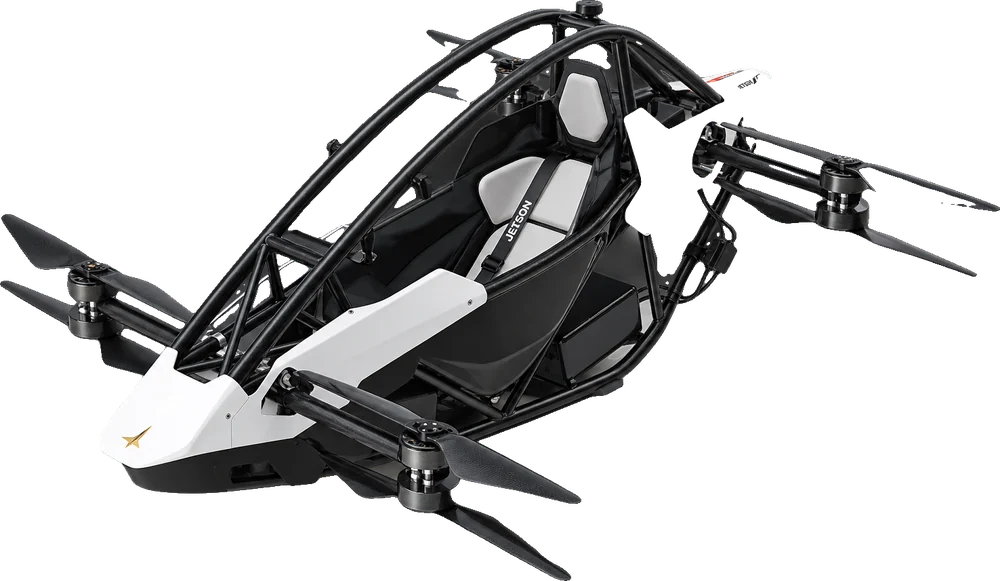
A single-seat personal eVTOL you sit in like a race car: eight motors, a joystick and a ballistic parachute, built for recreational flying rather than getting from A to B.
Jetson reports its 2025–26 production as sold out, with new orders for 2027.
How it works
6 ideas that make Jetson ONE different
Eight motors, one can fail
Its eight motors are arranged so it can keep flying with any one of them out, and three flight computers check each other so a single fault can't bring it down.
Flown with a joystick
A single 4-axis joystick does the flying: one hand controls climb, turn and direction while the flight computers keep it stable underneath.
It watches the ground
A lidar sensor tracks the terrain below and spots obstacles ahead, helping the pilot keep a safe height and avoid collisions.
Mostly battery
The aluminium frame and motors weigh just 55 kg. Batteries add another 60 kg, making up more than half of the 115 kg aircraft, which shows how much weight electric flight spends on stored energy.
A parachute for the worst case
A ballistic parachute fires out within moments to lower the whole aircraft and pilot if everything else fails.
Speed capped in software
Top speed is limited by software to 102 km/h: a deliberate cap set by Jetson, not the most the motors could manage.
Watch it fly
Jetson ONE - Police got a Flying Car in Florida — Jetson (official). Official Jetson footage.
Full specifications
Compare with other eVTOLsFigures are the maker's own unless marked as a third-party figure. Nothing below has been independently verified.
Identity
Configuration
What this means
Manual means a person on board flies it, usually helped by computers that keep it stable. Autonomous means no pilot at all: the aircraft follows a planned route and is watched from the ground.
What this means
Very light single-seat aircraft can fall under ultralight rules, which in some countries (including the US) need no pilot's licence. Heavier or passenger-carrying aircraft need a licensed pilot, or no pilot at all if certified as autonomous. Rules differ by country.
What this means
A multicopter uses many rotors for both lifting and moving, like a big drone: simple, but energy-hungry. Designs with a wing use the rotors to take off, then let the wing carry the weight in forward flight, which goes faster and farther on the same battery.
Performance
What this means
The heaviest the aircraft is allowed to be when it leaves the ground, fully loaded. Subtract the empty weight and you get how much it can carry. Electric aircraft are heavy for their size because batteries hold far less energy per kilogram than fuel.
What this means
Max speed is the fastest an aircraft may fly; cruise speed is the efficient pace it normally travels at, and is always lower. Each figure here says which one it is, so compare like with like.
What this means
How high an eVTOL may fly is often set by law or by software rather than by what the aircraft could physically do. Ultralights, for instance, are restricted to low altitudes, and most eVTOLs are designed to fly a few hundred metres up.
Power
Safety
What this means
Aircraft that carry passengers commercially need a type certificate (the design is safe), a production certificate (it can be built consistently) and an operator certificate (a company may fly it for paying customers). Ultralights skip most of this, which is why they reach buyers sooner.
Sources
Last checked 2026-10-22.