Yangwang (BYD) · China
U9 Xtreme
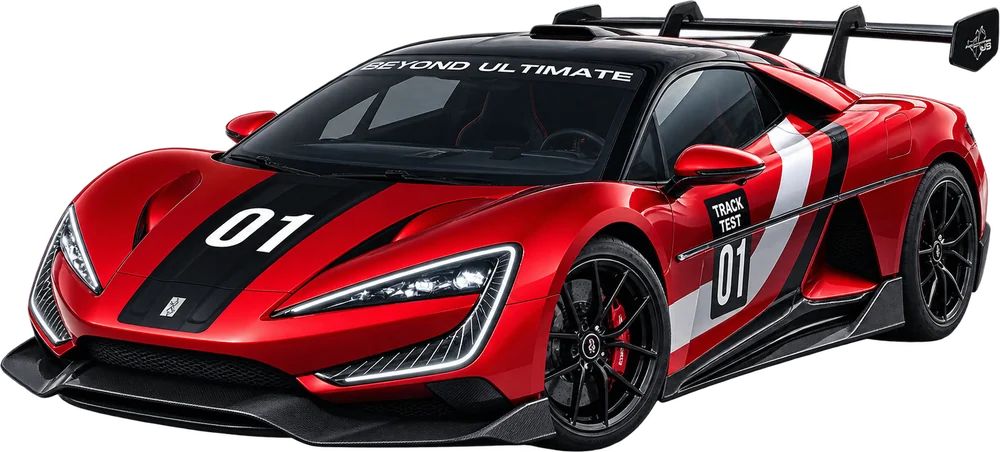
BYD's track-focused hypercar: four motors, more than 3,000 PS and a 1,200-volt system. In 2025 it reached 496.22 km/h, faster than any production car before it.
Limited to 30 cars worldwide. Yangwang publishes few everyday figures for the Xtreme; where the page notes the standard U9, that is the regular road version.
How it works
5 ideas that make U9 Xtreme different
Loading 3D model…
AI-generated 3D model
Drag to turn it, scroll or pinch to zoom, right-drag or two fingers to move.
A motor at every wheel
Four motors, one per wheel, each produce 555 kW. Because each wheel is driven separately, the computer can speed one up and slow another to help steer the car through a corner, as well as push it forward.
1,200 volts
Doubling the voltage halves the current needed for the same power, so cables and motors can be lighter and run cooler. Yangwang says the Xtreme is the first production car built on a 1,200-volt system.
A battery built to be drained fast
Its Blade battery is rated to discharge at 30C, meaning it could in theory empty in about two minutes. That's what lets it feed over 2,200 kW to the motors during a top-speed run.
Tyres for 500 km/h
At nearly 500 km/h, each tyre spins over 60 times a second. The Xtreme runs special tyres developed for those forces, described as the first Chinese-made tyres able to withstand 500 km/h.
The record, with a footnote
Its 496.22 km/h run beat any production car before it, but was driven in one direction only. Official records average two runs in opposite directions to cancel out wind and slope.
Watch it drive
YANGWANG U9 Xtreme | 496.22 km/h Top Speed Run — BYD Europe (official). The record run at ATP Papenburg, Germany, on 14 September 2025.
Full specifications
Compare with other EV Sports CarsFigures are the maker's own unless marked as a third-party figure. Nothing below has been independently verified.
Identity
Performance
What this means
Electric motors deliver full pulling force from a standstill, with no gears to change, which is why electric cars dominate acceleration. Below about 2 seconds, the limit is mostly grip: how hard the tyres can push on the road before spinning.
What this means
Top speed is a test of power against air resistance, which rises with the square of speed: going from 300 to 400 km/h takes roughly twice the power. EVs have usually been limited here, because sustained high speed drains batteries and overheats motors quickly.
What this means
Power is how fast a car can turn stored energy into motion. One kilowatt is about 1.36 metric horsepower (PS). These cars produce several times the power of a typical family EV, often from three or four motors, one per wheel or axle.
What this means
The Nürburgring Nordschleife is a 20.8 km track in Germany with 73 corners. A lap time tests everything at once: acceleration, braking, cornering and whether the battery and motors can keep performing without overheating.
Battery and charging
What this means
Battery capacity, in kilowatt-hours, is the size of the fuel tank. Hypercars usually carry smaller batteries than you might expect, around 80–100 kWh, because a heavier battery slows a car down in corners and under braking.
What this means
A higher-voltage system moves the same power with less current, so cables can be thinner and lighter and charging can be faster. Most EVs use 400 V; these cars use 800 V or more.
What this means
Fast charging depends on how much power the battery can safely accept, not just the charger. Quoted times are usually for 10–80%, because charging slows down near full to protect the cells.
Body
What this means
Batteries are heavy, so electric sports cars weigh more than petrol ones of similar size. Weight blunts cornering and braking, which is why makers chase it with carbon fibre and smaller packs.
Sources
Last checked 2026-10-31.