Tesla · USA
Roadster Rocket
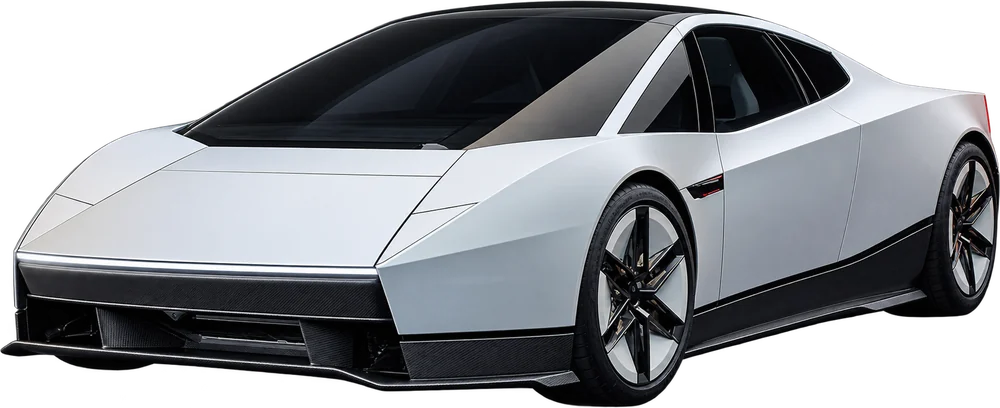
The top version of Tesla's second-generation Roadster: a single-seater with thrusters around its body that Tesla says can push it to 60 mph in under 0.59 seconds, and even lift it off the ground.
Unveiled on 15 October 2026, with production planned for 2028. All figures are Tesla's claims and haven't been independently tested. The Rocket is invitation-only and not approved for public roads.
How it works
4 ideas that make Roadster Rocket different
Loading 3D model…
Rear thrusters
Tesla's photos show a row of four rear-facing nozzles across the back of the car, above the fans. Tesla hasn't published how they work.
Why it matters
Tyres can only push a car forward as hard as they can grip the road. A thruster pushes against the air instead, so it adds acceleration that doesn't depend on grip, which is how Tesla claims a sub-0.59-second sprint to 60 mph.
Suction fans
Four fans sit low at the back. Tesla describes a 'multi-mode fan and ground sealing system' that pulls air from beneath the car to press it onto the road.
Why it matters
Downforce normally comes from wings, which only work at speed. Fans that pull air from under the car create a low-pressure zone beneath it, sucking it onto the road even when it's moving slowly, for more grip in corners and off the line.
Corner thrusters
Downward-firing thrusters sit near the wheels: Tesla's rear photo shows one at each back corner, and the reveal footage shows more beside the front wheels.
Why it matters
Thrusters pointing at the ground push the car upwards. Firing them together could make it hover or hop, and firing one side harder than the other tilts it, the same principle eVTOLs use with their rotors.
AI-generated 3D model
Drag to turn it, scroll or pinch to zoom, right-drag or two fingers to move. Tap a glowing part to see what it does.
Thrust beyond the tyres
A car's acceleration is normally capped by how hard its tyres can grip the road. The Rocket adds thrusters around its body, which push the car directly, so its acceleration isn't limited by grip alone.
Tesla says it can fly
Tesla showed a Rocket driving up a ramp, lifting off, flipping and landing. That makes it a stunt machine as much as a car, and it isn't approved for public roads.
Three versions, three purposes
The Roadster comes in three versions. Performance is the road car, and Thrust adds rear thrusters for racing. The single-seat Rocket is the extreme version, available by invitation only.
Claims, not yet tests
No one outside Tesla has timed or measured the Roadster yet. Its figures are what Tesla announced at the October 2026 reveal, nearly nine years after it first showed the car.
Watch it drive
The Ramp | Roadster — Tesla (official). Tesla's live ramp demo from the October 2026 reveal event.
Full specifications
Compare with other EV Sports CarsFigures are the maker's own unless marked as a third-party figure. Nothing below has been independently verified.
Identity
Performance
What this means
Electric motors deliver full pulling force from a standstill, with no gears to change, which is why electric cars dominate acceleration. Below about 2 seconds, the limit is mostly grip: how hard the tyres can push on the road before spinning.
What this means
Top speed is a test of power against air resistance, which rises with the square of speed: going from 300 to 400 km/h takes roughly twice the power. EVs have usually been limited here, because sustained high speed drains batteries and overheats motors quickly.
What this means
Power is how fast a car can turn stored energy into motion. One kilowatt is about 1.36 metric horsepower (PS). These cars produce several times the power of a typical family EV, often from three or four motors, one per wheel or axle.
What this means
The Nürburgring Nordschleife is a 20.8 km track in Germany with 73 corners. A lap time tests everything at once: acceleration, braking, cornering and whether the battery and motors can keep performing without overheating.
Battery and charging
What this means
Battery capacity, in kilowatt-hours, is the size of the fuel tank. Hypercars usually carry smaller batteries than you might expect, around 80–100 kWh, because a heavier battery slows a car down in corners and under braking.
What this means
A higher-voltage system moves the same power with less current, so cables can be thinner and lighter and charging can be faster. Most EVs use 400 V; these cars use 800 V or more.
What this means
Fast charging depends on how much power the battery can safely accept, not just the charger. Quoted times are usually for 10–80%, because charging slows down near full to protect the cells.
Body
What this means
Batteries are heavy, so electric sports cars weigh more than petrol ones of similar size. Weight blunts cornering and braking, which is why makers chase it with carbon fibre and smaller packs.
Sources
Last checked 2026-10-31.