
SpaceX · USA
Falcon 9
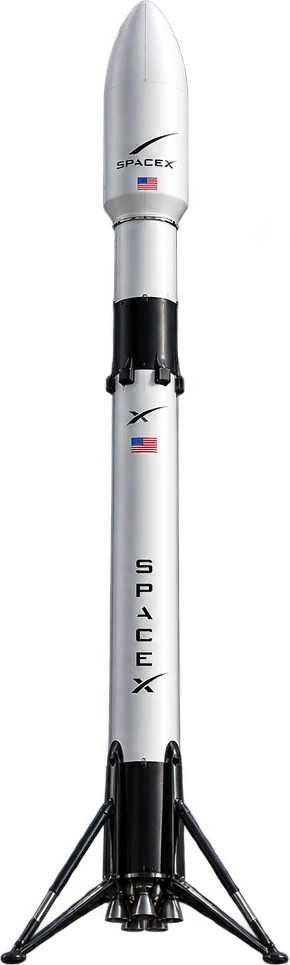
The rocket that made reuse routine: its first stage lands upright after nearly every launch, and one booster has now flown 37 times.
The world's most-flown active rocket, launching satellites, cargo and astronauts.
How it works
5 ideas that make Falcon 9 different
Flying back down
After separating, the first stage flips round, restarts some of its engines to slow down, and lands upright on a drone ship at sea or a pad on land. That lets the most expensive part of the rocket fly again.
Grid fins to steer
Four waffle-like grid fins near the top unfold on the way down. Moving them steers the falling booster through the air towards its landing spot.
Nine engines, one design
Nine identical Merlin engines power the first stage, and a vacuum version powers the upper stage. Building one engine type in large numbers keeps costs down.
Kerosene and soot
Falcon 9 burns rocket-grade kerosene, which is dense and proven but leaves soot inside the engines. That's one reason newer reusable rockets, including SpaceX's own Starship, switched to methane.
Reuse as routine
Over 650 booster landings have turned reuse from an experiment into normal practice. Most Falcon 9 launches now fly on boosters that have flown before.
Watch it launch
Falcon 9 | Overview — SpaceX (official). SpaceX's overview of Falcon 9.
Full specifications
Compare with other RocketsFigures are the maker's own unless marked as a third-party figure. Nothing below has been independently verified.
Identity
Size and lift
What this means
Low Earth orbit (LEO) is roughly 200–2,000 km up, where most satellites and space stations fly. Payload to LEO is the standard way to compare a rocket's lifting power. Recovering a booster costs payload, because it must keep fuel back to fly home and land.
Propulsion
What this means
Thrust is the push the engines produce. To leave the pad, it must exceed the rocket's weight; the extra is what accelerates it upward. 1 meganewton (MN) is roughly the force needed to hold up 100 tonnes.
What this means
Most new reusable rockets burn liquid methane with liquid oxygen. It burns cleanly, leaving little soot in the engines, so they can fly again with less refurbishment. Kerosene is denser and long proven but leaves soot behind; hydrogen gives the most energy per kilogram but needs huge, very cold tanks.
Reuse and record
What this means
Most rockets throw their stages away after one flight, like flying a plane once and scrapping it. Landing and reusing the booster, the biggest and most expensive part, is what has made launches more frequent and cheaper over the past decade.
Sources
Last checked 2026-10-31.