
Rocket Lab · USA / New Zealand
Neutron
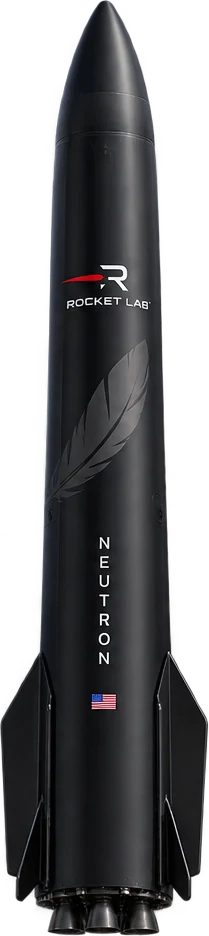
A medium-lift rocket built from carbon fibre, with a nose cone that opens like a clamshell and stays attached, so the whole first stage, fairing included, can fly back and be reused.
Not yet flown. On 14 October 2026 Rocket Lab moved its first launch to 2027, after a fault found while building a fuel tank.
How it works
4 ideas that make Neutron different
A nose that opens
Most rockets drop their nose-cone halves, which fall into the sea. Neutron's fairing opens like jaws to release the satellite, stays attached, and flies home with the first stage.
Upper stage inside
The small upper stage hangs hidden inside the booster rather than sitting on top. That lets the booster carry the strong, reusable structure, while the throwaway upper stage is kept light and cheap.
Carbon fibre body
Neutron is built from carbon composite, lighter than metal for its strength. Rocket Lab's delays have come from manufacturing it: a tank burst in testing in January 2026, and another defect was found in October.
Wide at the bottom
Neutron tapers from 7 m at the base to 5 m at the top. The wide, short shape makes it stable for landing and gives the engines room.
Watch it launch
Rocket Lab | This is Neutron — Rocket Lab (official). Rocket Lab's introduction to Neutron; computer animation, as it hasn't flown yet.
Full specifications
Compare with other RocketsFigures are the maker's own unless marked as a third-party figure. Nothing below has been independently verified.
Identity
Size and lift
What this means
Low Earth orbit (LEO) is roughly 200–2,000 km up, where most satellites and space stations fly. Payload to LEO is the standard way to compare a rocket's lifting power. Recovering a booster costs payload, because it must keep fuel back to fly home and land.
Propulsion
What this means
Thrust is the push the engines produce. To leave the pad, it must exceed the rocket's weight; the extra is what accelerates it upward. 1 meganewton (MN) is roughly the force needed to hold up 100 tonnes.
What this means
Most new reusable rockets burn liquid methane with liquid oxygen. It burns cleanly, leaving little soot in the engines, so they can fly again with less refurbishment. Kerosene is denser and long proven but leaves soot behind; hydrogen gives the most energy per kilogram but needs huge, very cold tanks.
Reuse and record
What this means
Most rockets throw their stages away after one flight, like flying a plane once and scrapping it. Landing and reusing the booster, the biggest and most expensive part, is what has made launches more frequent and cheaper over the past decade.
Sources
Last checked 2026-10-31.