Unitree Robotics · China
H2 EDU
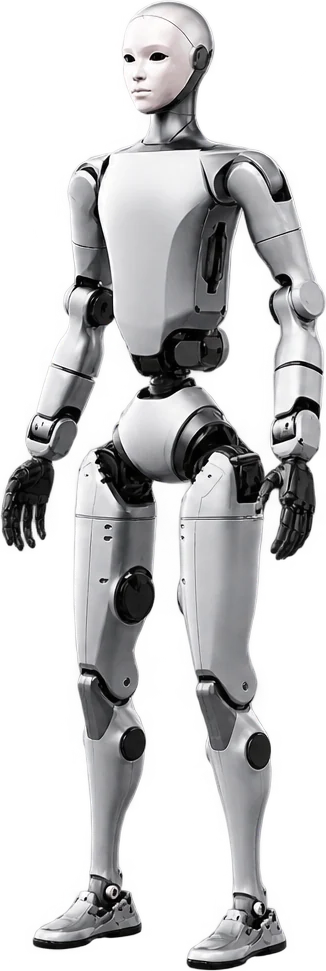
Unitree's tallest humanoid in its developer configuration: full-size, fitted with dexterous hands (several models to choose from), a second onboard computer and full SDK access for researchers and developers.
Sold in two versions: the base H2 without hands, and the H2 EDU shown here, with dexterous hands, an optional AI computer and full developer access. EDU pricing is on request.
How it works
6 ideas that make H2 EDU different
Numbers mark where each idea sits on the robot.
A bionic face
Unitree gives H2 a bionic head with human facial features. Behind the face sit a wide-angle binocular camera, a microphone array and a speaker for voice interaction.
Fast, cool-running joints
Each joint uses a low-inertia internal-rotor motor, which speeds up response and sheds heat better, on industrial crossed-roller bearings that carry heavy loads precisely.
Legs three times stronger than arms
Leg joints peak at 360 N·m against 120 N·m in the arms. The legs carry the whole 70 kg body, absorb landings and power the dancing and kicking moves Unitree shows in its videos.
Two computers, two jobs
One onboard computer runs Unitree's own balance and motion control; a second is reserved for the developer's code. The EDU can add a high-power AI module such as NVIDIA Thor for running AI models.
Built to be reprogrammed
H2 EDU ships with an open SDK in C++ and Python plus ROS 2. Developers write their own behaviours on top of Unitree's walking controller; the base H2 doesn't allow this.
Hands you choose
The EDU accepts several dexterous hand models, so finger count and grip depend on the hand fitted. That is why its hand degrees of freedom have no single figure.
Watch it move
Unitree Introducing | Unitree H2 Destiny Awakening! — Unitree Robotics (official). Unitree's launch video for H2, shown with hands.
Full specifications
Compare with other humanoidsFigures are the maker's own unless marked as a third-party figure. Nothing below has been independently verified.
Identity
Body
What this means
Each degree of freedom is one joint that can move on its own. More joints mean more human-like movement, but also more motors to power and control. Hands are where counts climb fastest: a dexterous hand alone can have 10 to 20.
Performance
What this means
How much a robot can lift is quoted in very different ways: per arm or with the whole body, as a brief peak or something it can hold all shift. Only figures measured the same way can be compared.
What this means
Hours on one charge mean little without the conditions: standing still drains far less than walking or carrying loads. A robot that swaps its battery can work longer than its runtime suggests.
What this means
The IP code says how well the robot is sealed: the first digit is dust, the second water. IP67 means dust-tight and able to survive brief submersion, which matters in factories that are hosed down.
Intelligence
What this means
Who is really in control. A teleoperated robot is driven by a person; a scripted one replays programmed moves; a learned policy decides for itself from training. Demos often mix all three without saying so.
Market
Sources
Last checked 2026-10-19.