UBTech Robotics · China
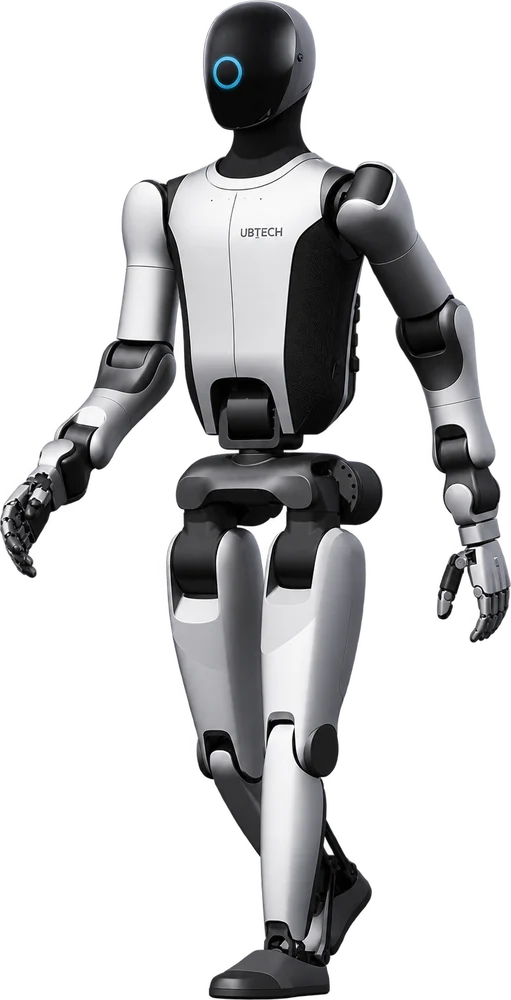
Walker S2
UBTech's industrial humanoid, already working in car factories. It was the first humanoid shown swapping its own batteries, which lets it keep working around the clock.
In mass production since November 2025. UBTech reported 1,000 units built and more than 500 delivered by December 2025, to carmakers including BYD and Geely, and to Foxconn.
How it works
6 ideas that make Walker S2 different
Numbers mark where each idea sits on the robot.
Batteries it changes itself
Two battery packs sit in its back. When one runs low, it walks to a swap station, twists its torso into position and uses its own arms to pull the spent pack and slot in a charged one, in about three minutes.
It never powers down
Because it can run on either battery alone, the robot stays switched on while one pack is out. That hot-swapping is what makes round-the-clock shifts possible without a restart.
It decides when to swap
The robot tracks its battery in real time and weighs it against the task in hand, choosing whether to swap now, carry on, or plug in to charge.
Depth from two cameras
A pair of ordinary colour cameras, like two eyes, feeds a deep-learning model that estimates how far away everything is, producing a live depth map for grasping and walking.
A waist that turns and bends
A high-torque waist rotates ±162° and bends through 125°, so it can reach anything from floor level to 1.8 m high without moving its feet.
Built to work in teams
UBTech's BrainNet 2.0 and Co-Agent software split planning from execution and coordinate several robots on one production line, which UBTech calls swarm intelligence.
Watch it move
Walker S2 - The World's First Humanoid Robot Capable of Autonomous Battery Swapping — UBTECH Robotics (official). UBTech's demonstration of autonomous battery swapping.
Full specifications
Compare with other humanoidsFigures are the maker's own unless marked as a third-party figure. Nothing below has been independently verified.
Identity
Body
What this means
Each degree of freedom is one joint that can move on its own. More joints mean more human-like movement, but also more motors to power and control. Hands are where counts climb fastest: a dexterous hand alone can have 10 to 20.
Performance
What this means
How much a robot can lift is quoted in very different ways: per arm or with the whole body, as a brief peak or something it can hold all shift. Only figures measured the same way can be compared.
What this means
Hours on one charge mean little without the conditions: standing still drains far less than walking or carrying loads. A robot that swaps its battery can work longer than its runtime suggests.
What this means
The IP code says how well the robot is sealed: the first digit is dust, the second water. IP67 means dust-tight and able to survive brief submersion, which matters in factories that are hosed down.
Intelligence
What this means
Who is really in control. A teleoperated robot is driven by a person; a scripted one replays programmed moves; a learned policy decides for itself from training. Demos often mix all three without saying so.
Market
Sources
Last checked 2026-10-20.