
EngineAI · China
T800
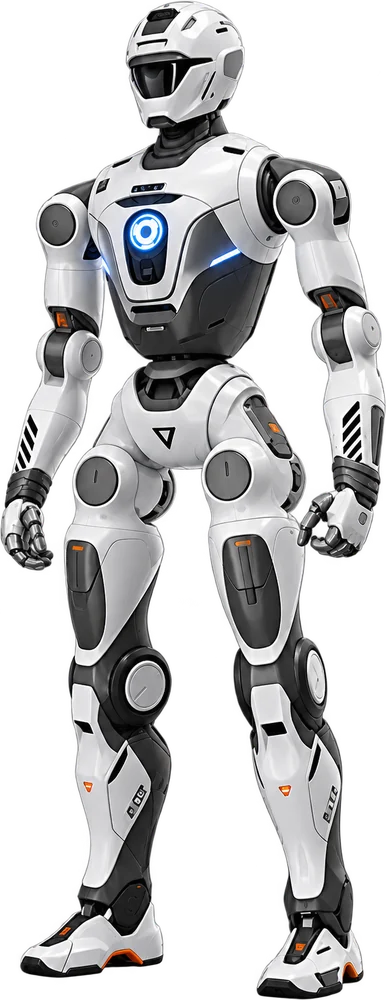
EngineAI's full-size "high-dynamic" humanoid, built for power: its leg joints deliver up to 450 N·m, the most of any robot here, and are actively cooled. Known for kung-fu-style demos, it began mass deliveries in 2026.
The first batch entered mass delivery from EngineAI's new Shenzhen factory in late May 2026. Sold in four editions, from Basic (no hands, no LiDAR) to MAX; figures here are for the top MAX edition unless noted.
How it works
6 ideas that make T800 different
Loading 3D model…
Head cameras
EngineAI's own ultra-wide binocular cameras in the head.
Why it matters
Two cameras set slightly apart, like human eyes, let software judge distance by comparing the two views. That is how the robot finds things to pick up, people to face and where to put its feet. Wide-angle lenses take in more of the room at once.
Neck LiDAR
A 3D LiDAR in the neck, on the Open Source, PRO and MAX editions, for 360° perception.
Why it matters
LiDAR fires laser pulses and times their return, building a precise 3D map of everything around the robot, even in the dark. Robots use it to navigate, steer around people and obstacles, and keep track of where they are in a building.
AI-generated 3D model
Drag to turn it, scroll or pinch to zoom, right-drag or two fingers to move. Tap a glowing part to see what it does.
The strongest joints here
Its leg joints reach up to 450 N·m of peak torque, more than any other robot on this site. That burst of turning force is what lets it jump, spin and land kicks.
Cooled like an engine
High-power joints get hot fast. The T800 actively air-cools its leg joints, so it can keep up hard movement for hours instead of having to stop and cool down.
Motors built for speed
Each joint uses a high-speed internal-rotor permanent-magnet motor, the same type as Unitree's H2, driving planetary gears on crossed-roller bearings that carry heavy loads precisely.
An aircraft-grade frame
The body is built from aviation aluminium and titanium, keeping it light for its strength and stiff enough to absorb hard landings.
Eyes in the head, laser in the neck
Wide-angle binocular cameras in the head and a 3D LiDAR in the neck give it a 360° picture of its surroundings for moving quickly without collisions.
Tested on stage
EngineAI uses combat events and stunt demos to stress-test its hardware in public, and to prove it is real: its CEO let a T800 kick him to answer doubts about its launch video.
Watch it move
EngineAI T800: Born to Disrupt! — EngineAI (official). EngineAI's launch video, a stylised action sequence; EngineAI says it is real footage, not sped up.
Full specifications
Compare with other HumanoidsFigures are the maker's own unless marked as a third-party figure. Nothing below has been independently verified.
Identity
Body
What this means
Each degree of freedom is one joint that can move on its own. More joints mean more human-like movement, but also more motors to power and control. Hands are where counts climb fastest: a dexterous hand alone can have 10 to 20.
Performance
What this means
How much a robot can lift is quoted in very different ways: per arm or with the whole body, as a brief peak or something it can hold all shift. Only figures measured the same way can be compared.
What this means
Hours on one charge mean little without the conditions: standing still drains far less than walking or carrying loads. A robot that swaps its battery can work longer than its runtime suggests.
What this means
The IP code says how well the robot is sealed: the first digit is dust, the second water. IP67 means dust-tight and able to survive brief submersion, which matters in factories that are hosed down.
Intelligence
What this means
Who is really in control. A teleoperated robot is driven by a person; a scripted one replays programmed moves; a learned policy decides for itself from training. Demos often mix all three without saying so.
Market
Sources
- en.engineai.com.cn
- www.humanoidsdaily.com
- www.humanoidsdaily.com
- www.prnewswire.com
- www.notebookcheck.net
Last checked 2026-10-20.