Doroni Aerospace · USA
H1-X
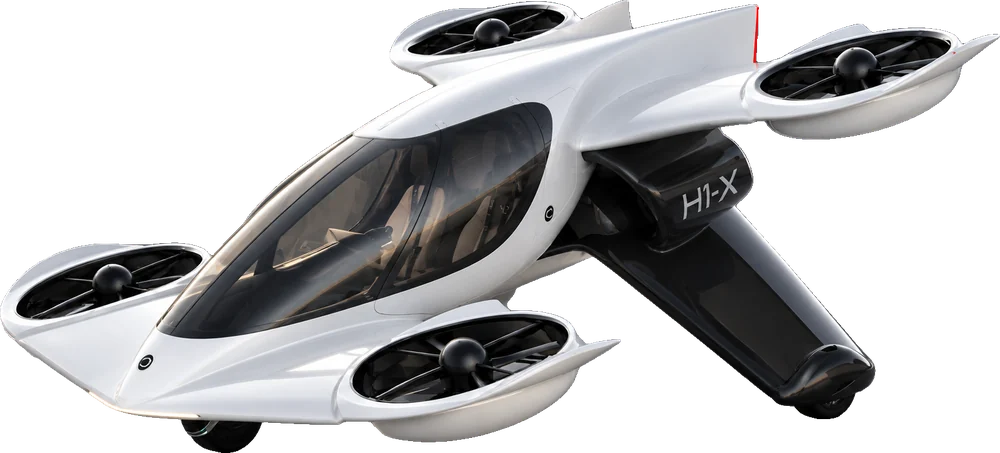
A two-seat personal eVTOL from Florida that lifts off on ducted fans hidden in its tandem wings, then flies forward on two separate thrust fans, with nothing that tilts.
Doroni reports 600+ pre-orders and estimates deliveries from 2028. A full-size mockup has been shown, but no H1-X flight tests have been published.
How it works
6 ideas that make H1-X different
Ducted lift fans
Lift fans sit in stacked pairs inside ducts along the wings. The duct guards the blades, and Doroni says it makes them about 20% more efficient.
Why it matters
The lower rotor works in air the upper one has already pushed downward, so it gets less grip. Adding it gives about 65–80% more lift, not double, and for the same lift a stacked pair uses roughly a quarter more power than two separate rotors. Makers accept that for three gains: twice the rotors in the same footprint, a backup motor on every arm, and steering, because the two spin in opposite directions and changing their balance turns the aircraft.
Front-right duct
For a vertical take-off, all eight lift fans speed up together to raise the H1-X off a driveway-sized space.
Why it matters
To go up, the flight computer speeds up every motor at once, so the rotors push down more air than the aircraft weighs. To come down, it slows them all evenly. Hovering means holding the push exactly equal to the weight.
Rear-right duct
Shifting thrust between the front and rear ducts tips the aircraft, which is how it moves while hovering.
Why it matters
To move, the computer speeds up the rotors on one side and slows those opposite. The aircraft tips towards the slower side, part of the rotors' push now points sideways, and it moves that way: forward, back or sideways.
Rear-left duct
Trimming fans that spin one way against those spinning the other turns the H1-X on the spot.
Why it matters
Every spinning rotor tries to twist the aircraft the opposite way. Half spin clockwise and half anticlockwise, so the twists cancel. To turn on the spot, the computer speeds up one set and slows the other, and the leftover twist rotates the aircraft.
Pusher fans
Under the rear wing hang the pusher fans that drive the H1-X forward once it is airborne, while the wings take over the lifting.
Why it matters
Lift fans are good at hovering but inefficient at pushing an aircraft forward. A separate pusher fan handles cruise while the wings take over the lifting, so each set of fans only does the job it's best at, and nothing has to tilt.
Cockpit
Two seats under a wide canopy. The pilot flies with a joystick, and take-off and landing are automated at the push of a button.
Why it matters
The pilot never controls motors one by one. The controls tell the flight computer where to go, and it works out how fast each rotor must spin to get there while keeping the aircraft level.
Tap a glowing part to see what it does.
Fans hidden in the wings
The lift fans sit in stacked pairs inside ducts along the wings. The ducts guard people from the spinning blades when climbing in and out, and Doroni says they make the fans about 20% more efficient than open propellers.
One set to lift, another to cruise
The lift fans only push upward. Separate pusher fans below the rear wing drive it forward once airborne. Because nothing tilts, the only moving parts are the propellers themselves, which keeps the mechanics simple.
Two wings, one behind the other
Tandem wings carry the weight once it's moving forward, so it flies more like a small plane than a drone. Wings are far more efficient than fans at holding an aircraft up, which helps it reach a quoted range of 100 miles.
Push-button take-off and landing
The pilot flies with a joystick, but take-off and landing are automated at the press of a button. Doroni plans its Soul.AI co-pilot to add weather and airspace warnings and voice control.
Charges like an EV
Doroni quotes a 25-minute charge and says the aircraft can use standard electric-car charging, so it could be charged at home, with swappable battery packs as an alternative.
Backups and a parachute
With ten motors and duplicated avionics, the H1-X is designed to land safely if some fans fail, and a whole-aircraft ballistic parachute is the last resort.
Watch it fly
A Picnic Date With The H1-X Flying Car — Doroni Aerospace (official). Doroni's computer-animated visualisation, not real flight footage.
Full specifications
Compare with other eVTOLsFigures are the maker's own unless marked as a third-party figure. Nothing below has been independently verified.
Identity
Configuration
What this means
Manual means a person on board flies it, usually helped by computers that keep it stable. Autonomous means no pilot at all: the aircraft follows a planned route and is watched from the ground.
What this means
Very light single-seat aircraft can fall under ultralight rules, which in some countries (including the US) need no pilot's licence. Heavier or passenger-carrying aircraft need a licensed pilot, or no pilot at all if certified as autonomous. Rules differ by country.
What this means
A multicopter uses many rotors for both lifting and moving, like a big drone: simple, but energy-hungry. Designs with a wing use the rotors to take off, then let the wing carry the weight in forward flight, which goes faster and farther on the same battery.
Performance
What this means
The heaviest the aircraft is allowed to be when it leaves the ground, fully loaded. Subtract the empty weight and you get how much it can carry. Electric aircraft are heavy for their size because batteries hold far less energy per kilogram than fuel.
What this means
Max speed is the fastest an aircraft may fly; cruise speed is the efficient pace it normally travels at, and is always lower. Each figure here says which one it is, so compare like with like.
What this means
How high an eVTOL may fly is often set by law or by software rather than by what the aircraft could physically do. Ultralights, for instance, are restricted to low altitudes, and most eVTOLs are designed to fly a few hundred metres up.
Power
Safety
What this means
Aircraft that carry passengers commercially need a type certificate (the design is safe), a production certificate (it can be built consistently) and an operator certificate (a company may fly it for paying customers). Ultralights skip most of this, which is why they reach buyers sooner.
Sources
Last checked 2026-10-27.