WeRide · China
Robotaxi GXR
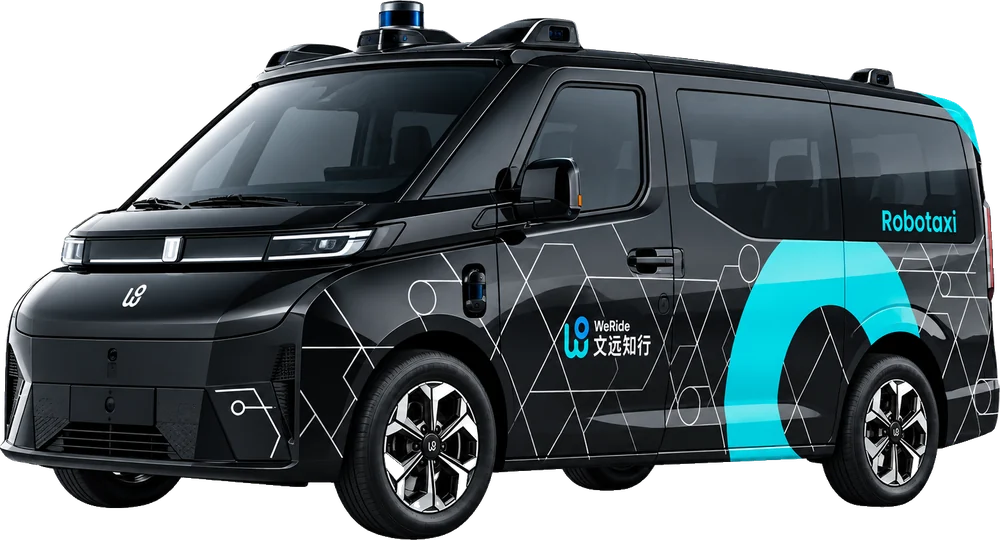
WeRide's purpose-built robotaxi van, built with Geely Farizon: no front passenger seat, an extra-wide door opening, and a new long-range lidar in its upgraded version.
The GXR runs WeRide's driverless services in cities including Guangzhou, Abu Dhabi and Dubai. An upgraded version with WeRide's GEN8 sensors is due to start production in Q3 2026.
How it works
5 ideas that make Robotaxi GXR different
No front passenger seat
Removing the front passenger seat gives riders behind more legroom: over half a metre in the second row. In a car nobody drives, the front of the cabin no longer needs to be built around a person.
A doorway, not a door
With a hidden B-pillar, the front door and the sliding side door open together, leaving a gap 1.83 m wide that makes climbing in with luggage easier.
Seeing 600 metres ahead
The upgraded GEN8 version uses a lidar with about 17 times more detail, detecting objects up to 600 m away, two to three times further than common setups, which buys more time to react at speed.
Built in minutes
With Geely Farizon, WeRide says fitting its self-driving system now takes under 10 minutes per vehicle instead of an hour, cutting the cost of each car by a further 15%.
Beyond China
WeRide runs robotaxis well beyond China, from Guangzhou and Beijing to Abu Dhabi, Dubai, Singapore and Zurich, often booked through partners such as Uber and Grab.
Watch it drive
WeRide Unveils New Production Robotaxi GXR Leveraging 1,800 Days of Operations — WeRide (official). WeRide's 2024 launch video for the GXR, before the GEN8 upgrade.
Full specifications
Compare with other RobotaxisFigures are the maker's own unless marked as a third-party figure. Nothing below has been independently verified.
Identity
Service
What this means
Miles driven with no human ready to take over, across the company's whole fleet. Most were driven by older vehicles, so this measures each company's experience rather than the car shown. Companies count differently, so check the note under each figure.
Cabin
What this means
A car built without a steering wheel or pedals can never be driven by a person, so it has to be fully self-driving everywhere it goes. Removing them frees up space, but in most countries it also needs special approval from regulators.
Sensing
What this means
Cameras see colour, text and signals, like traffic lights and road markings, and are cheap. On their own they have to estimate distance from the image, and they struggle in glare and darkness.
What this means
Lidar fires laser pulses and times their return, measuring the exact distance to everything around the car in 3D, day or night. It adds cost, which is why Tesla leaves it out and relies on cameras alone.
What this means
Radar uses radio waves to measure distance and speed. It sees through rain, fog and spray where cameras and lidar struggle, but in less detail.
Power and performance
Safety
Sources
Last checked 2026-10-23.