Waymo · USA
Ojai
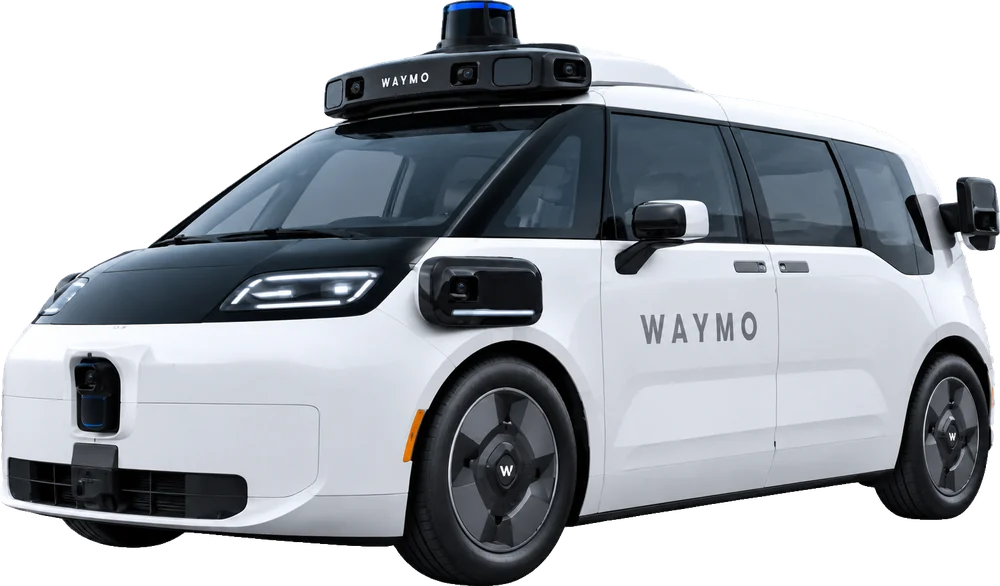
Waymo's sixth-generation robotaxi: a boxy electric van built by Zeekr, carrying up to four riders and seeing the road with cameras, lidar and radar together.
Open to all riders since August 2026, starting in San Francisco, Phoenix and Los Angeles. Most of Waymo's fleet is still the older Jaguar I-PACE.
How it works
6 ideas that make Ojai different
Three ways of seeing
Cameras read colours and signs, lidar measures exact distances with lasers, and radar sees through rain and spray. Each covers the others' blind spots, so the car is never relying on a single kind of sensor.
Fewer, better cameras
Waymo cut its camera count to 13, less than half the previous generation, by using sharper ones, including a 17-megapixel imager. Fewer sensors make the car cheaper to build in large numbers.
It listens too
Microphones around the roof dome pick up sirens and railway crossing bells, so the car can make way for an emergency vehicle even before it comes into view.
Wipers for its eyes
Small wipers and washers keep each sensor clean. A camera covered in grime or ice is as bad as no camera, so cleaning is part of the self-driving system.
Built for riders, not drivers
A lower step, a higher ceiling and no pillar between the doors make it easy to climb in, and with no steering wheel the front-left space is left empty.
Experience counts
Waymo's cars have driven over 270 million miles with no one at the wheel. The Ojai inherits software trained on all of them, even though most were driven by older Jaguars.
Watch it drive
Meet Ojai, equipped with our 6th-generation Waymo Driver now driving fully autonomously. — Waymo (official). Waymo's short introducing the Ojai as it began driving fully autonomously.
Full specifications
Compare with other RobotaxisFigures are the maker's own unless marked as a third-party figure. Nothing below has been independently verified.
Identity
Service
What this means
Miles driven with no human ready to take over, across the company's whole fleet. Most were driven by older vehicles, so this measures each company's experience rather than the car shown. Companies count differently, so check the note under each figure.
Cabin
What this means
A car built without a steering wheel or pedals can never be driven by a person, so it has to be fully self-driving everywhere it goes. Removing them frees up space, but in most countries it also needs special approval from regulators.
Sensing
What this means
Cameras see colour, text and signals, like traffic lights and road markings, and are cheap. On their own they have to estimate distance from the image, and they struggle in glare and darkness.
What this means
Lidar fires laser pulses and times their return, measuring the exact distance to everything around the car in 3D, day or night. It adds cost, which is why Tesla leaves it out and relies on cameras alone.
What this means
Radar uses radio waves to measure distance and speed. It sees through rain, fog and spray where cameras and lidar struggle, but in less detail.
Power and performance
Safety
Sources
Last checked 2026-10-23.