Baidu Apollo Go · China
Apollo RT6
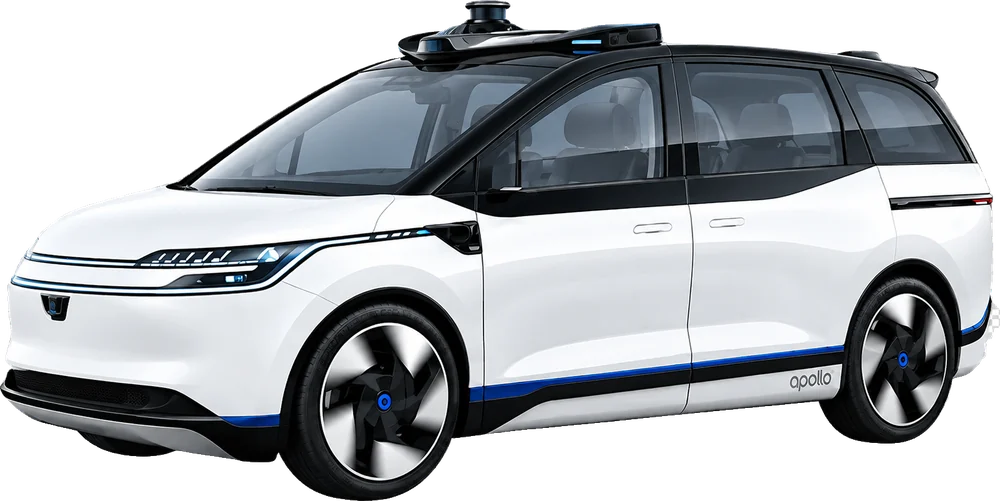
Baidu's sixth-generation robotaxi, built for its Apollo Go service: 38 sensors including eight lidars, and a steering wheel that can be removed altogether.
The RT6 is the main vehicle in Apollo Go, which runs commercial robotaxi services in cities including Wuhan, Beijing, Shenzhen, Chongqing and Dubai.
How it works
5 ideas that make Apollo RT6 different
Thirty-eight sensors
Eight lidars, twelve cameras, six radars and twelve ultrasonic sensors give it overlapping views on every side, so a failure or blind spot in one is covered by the others.
A wheel you can take out
The steering wheel can be removed altogether, freeing the front of the cabin for extra seats or other uses, such as a desk.
Two brains
Two separate computing units, rated at up to 1,200 TOPS (trillions of operations per second) in total, back each other up, so the car can still stop safely if one fails.
Built to be cheap
Baidu put its cost at about 250,000 yuan (about US$37,000), roughly half its previous robotaxi. A low price per car is what lets a service grow into thousands of vehicles.
Scale in China first
Apollo Go has driven over 240 million km with no one at the wheel, mostly in Chinese cities like Wuhan, before expanding to the Middle East and Europe.
Watch it drive
Say Hello to the Apollo RT6, Baidu's Next-Gen AV | Baidu Smart Transportation — Baidu Inc. (official). Baidu's launch video for the RT6.
Full specifications
Compare with other RobotaxisFigures are the maker's own unless marked as a third-party figure. Nothing below has been independently verified.
Identity
Service
What this means
Miles driven with no human ready to take over, across the company's whole fleet. Most were driven by older vehicles, so this measures each company's experience rather than the car shown. Companies count differently, so check the note under each figure.
Cabin
What this means
A car built without a steering wheel or pedals can never be driven by a person, so it has to be fully self-driving everywhere it goes. Removing them frees up space, but in most countries it also needs special approval from regulators.
Sensing
What this means
Cameras see colour, text and signals, like traffic lights and road markings, and are cheap. On their own they have to estimate distance from the image, and they struggle in glare and darkness.
What this means
Lidar fires laser pulses and times their return, measuring the exact distance to everything around the car in 3D, day or night. It adds cost, which is why Tesla leaves it out and relies on cameras alone.
What this means
Radar uses radio waves to measure distance and speed. It sees through rain, fog and spray where cameras and lidar struggle, but in less detail.
Power and performance
Safety
Sources
Last checked 2026-10-23.