AgiBot · China
A3 Ultra
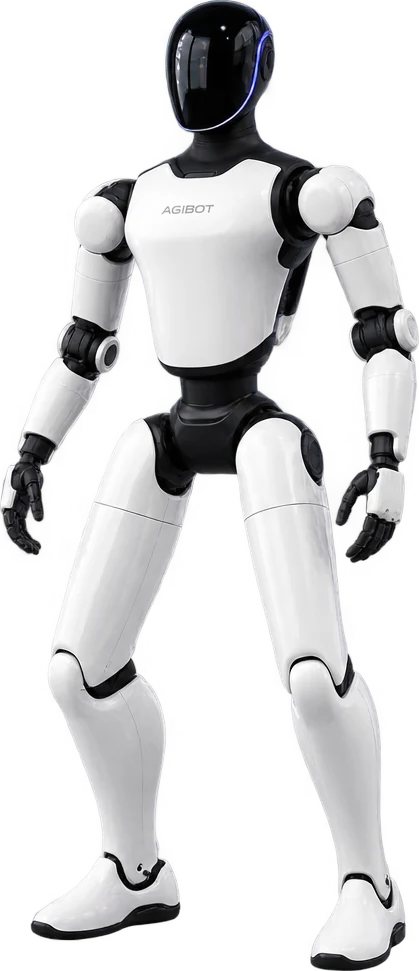
AgiBot's full-size service humanoid, built for long shifts in public spaces such as reception desks, shops and guided tours. It docks itself to charge and runs on NVIDIA Thor.
Unveiled at WAIC 2026 in Shanghai. AgiBot's main product menu still lists the A3; the A3 Ultra appears in its press release and developer documentation.
How it works
6 ideas that make A3 Ultra different
Numbers mark where each idea sits on the robot.
Three computers, three jobs
One board sits next to the motors and runs balance and motion. A second runs the head, sensors and networking. A third, NVIDIA Thor, runs the embodied AI, keeping heavy AI work separate from balance control.
Eyes all around
A chest depth camera watches the work area, a pelvis depth camera watches the ground, and three fisheye cameras plus 3D LiDAR cover the sides and back. Crowded public spaces demand 360° awareness.
Knows where it is, indoors and out
RTK GPS fixes its position outdoors to within centimetres, and UWB radio beacons locate it indoors. AgiBot says this supports navigation and coordinated operation across environments.
Never needs plugging in by hand
Two battery bays hold 1,152 Wh, about eight hours of mixed standing and walking. When low, it docks itself to charge in under two hours, or staff swap a pack.
A face made for conversation
A curved interactive screen sits on the head, with speakers on both sides and an eight-microphone array front and back that picks up voices from any direction.
Hands that scale
The optional dexterous hands have 10 degrees of freedom each, with an upgrade to 20. More finger joints means finer grasping, at the cost of more motors to control.
Watch it move
AGIBOT A3 Ultra is moving from mass production into real-world deployment. — AGIBOT (official). Official AgiBot footage.
Full specifications
Compare with other humanoidsFigures are the maker's own unless marked as a third-party figure. Nothing below has been independently verified.
Identity
Body
What this means
Each degree of freedom is one joint that can move on its own. More joints mean more human-like movement, but also more motors to power and control. Hands are where counts climb fastest: a dexterous hand alone can have 10 to 20.
Performance
What this means
How much a robot can lift is quoted in very different ways: per arm or with the whole body, as a brief peak or something it can hold all shift. Only figures measured the same way can be compared.
What this means
Hours on one charge mean little without the conditions: standing still drains far less than walking or carrying loads. A robot that swaps its battery can work longer than its runtime suggests.
What this means
The IP code says how well the robot is sealed: the first digit is dust, the second water. IP67 means dust-tight and able to survive brief submersion, which matters in factories that are hosed down.
Intelligence
What this means
Who is really in control. A teleoperated robot is driven by a person; a scripted one replays programmed moves; a learned policy decides for itself from training. Demos often mix all three without saying so.
Market
Sources
Last checked 2026-10-19.