Aridge (XPeng) · China
Flying Module
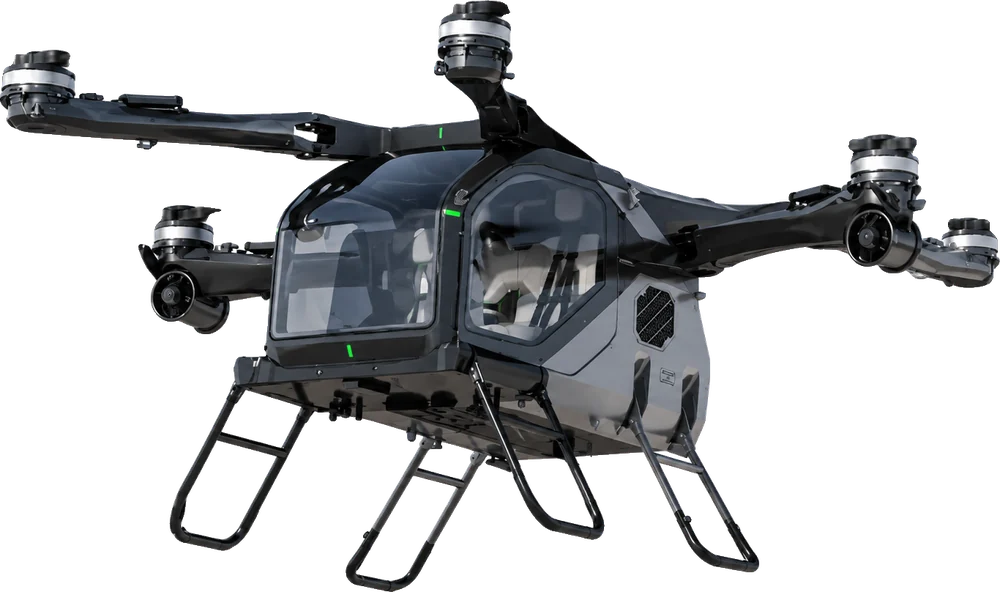
The aircraft half of Aridge's Land Aircraft Carrier: a two-seat, six-rotor eVTOL that folds up and rides in the back of a six-wheeled vehicle, which also recharges it between flights.
Mass production began in Guangzhou in November 2025, with customer deliveries planned for 2026. Aridge hasn't published the aircraft's weight, range, speed or flight time.
How it works
4 ideas that make Flying Module different
It travels in a car
Arms and rotor blades fold so the aircraft fits in the rear of the six-wheeled Land Aircraft Carrier. You drive to somewhere open, unfold it and take off.
A charging station on wheels
The carrier vehicle carries a mobile supercharger that recharges the aircraft while driving or parked. One full charge of the station covers up to six flights.
Fly it or let it fly
It can be flown with a single control stick, or handed over to an autopilot for the flight.
Built at car-factory scale
Aridge builds it in a dedicated plant in Guangzhou designed for thousands of units a year, far more than a typical aircraft factory.
Watch it fly
Safety Framework Explained: How We Elevate Flight Safety With Redundancy Systems — Aridge (official). Aridge explains its backup systems for flight safety.
Full specifications
Compare with other eVTOLsFigures are the maker's own unless marked as a third-party figure. Nothing below has been independently verified.
Identity
Configuration
What this means
Manual means a person on board flies it, usually helped by computers that keep it stable. Autonomous means no pilot at all: the aircraft follows a planned route and is watched from the ground.
What this means
Very light single-seat aircraft can fall under ultralight rules, which in some countries (including the US) need no pilot's licence. Heavier or passenger-carrying aircraft need a licensed pilot, or no pilot at all if certified as autonomous. Rules differ by country.
What this means
A multicopter uses many rotors for both lifting and moving, like a big drone: simple, but energy-hungry. Designs with a wing use the rotors to take off, then let the wing carry the weight in forward flight, which goes faster and farther on the same battery.
Performance
What this means
The heaviest the aircraft is allowed to be when it leaves the ground, fully loaded. Subtract the empty weight and you get how much it can carry. Electric aircraft are heavy for their size because batteries hold far less energy per kilogram than fuel.
What this means
Max speed is the fastest an aircraft may fly; cruise speed is the efficient pace it normally travels at, and is always lower. Each figure here says which one it is, so compare like with like.
What this means
How high an eVTOL may fly is often set by law or by software rather than by what the aircraft could physically do. Ultralights, for instance, are restricted to low altitudes, and most eVTOLs are designed to fly a few hundred metres up.
Power
Safety
What this means
Aircraft that carry passengers commercially need a type certificate (the design is safe), a production certificate (it can be built consistently) and an operator certificate (a company may fly it for paying customers). Ultralights skip most of this, which is why they reach buyers sooner.
Sources
Last checked 2026-10-22.