AIR · Israel
AIR ONE
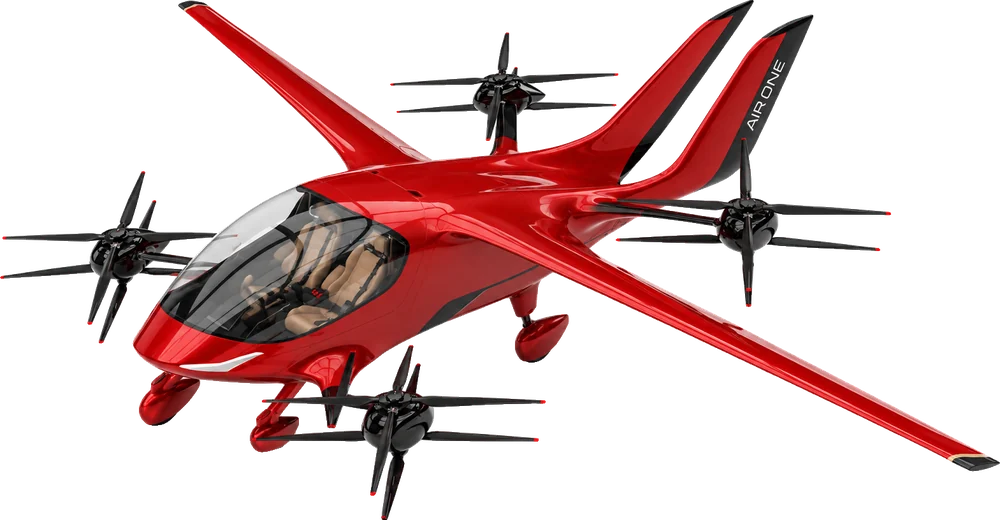
A two-seat winged eVTOL for private owners: it takes off like a drone, cruises on its wing, and folds to fit in a parking space. A cargo version is already delivering; the piloted version is still a prototype.
The uncrewed cargo version was first delivered in December 2025. The piloted two-seater has about 2,900 pre-orders but no published delivery date. Figures below are AIR's, as reported by the Vertical Flight Society.
How it works
6 ideas that make AIR ONE different
A wing for the journey
Rotors lift it off the ground, but in forward flight the wing carries the weight. That is why AIR estimates a cruise of about 249 km/h and 177 km of range, far beyond a pure multicopter.
Eight propellers, stacked
Its eight propellers sit in four stacked pairs. If one fails the others keep it flying, and if all stop, the wing lets it glide down to a runway or road.
Fly by intent
Rather than working each control surface, the pilot shows where to go and the computers work out how, a system AIR first developed for its drones.
Folds for the garage
The wings fold so the aircraft fits a car-sized parking space or a trailer, a job AIR says one person can do in five minutes.
A parachute on board
A whole-aircraft ballistic parachute is the last line of defence if an in-flight emergency can't be handled any other way.
Cargo first
AIR's first deliveries were an uncrewed cargo version carrying up to 250 kg, letting the design prove itself in service before passengers fly.
Watch it fly
Everything You Need to Know - AIR ONE | Electric VTOL — AIR (official). AIR's 2023 overview of the full-scale AIR ONE during flight testing.
Full specifications
Compare with other eVTOLsFigures are the maker's own unless marked as a third-party figure. Nothing below has been independently verified.
Identity
Configuration
What this means
Manual means a person on board flies it, usually helped by computers that keep it stable. Autonomous means no pilot at all: the aircraft follows a planned route and is watched from the ground.
What this means
Very light single-seat aircraft can fall under ultralight rules, which in some countries (including the US) need no pilot's licence. Heavier or passenger-carrying aircraft need a licensed pilot, or no pilot at all if certified as autonomous. Rules differ by country.
What this means
A multicopter uses many rotors for both lifting and moving, like a big drone: simple, but energy-hungry. Designs with a wing use the rotors to take off, then let the wing carry the weight in forward flight, which goes faster and farther on the same battery.
Performance
What this means
The heaviest the aircraft is allowed to be when it leaves the ground, fully loaded. Subtract the empty weight and you get how much it can carry. Electric aircraft are heavy for their size because batteries hold far less energy per kilogram than fuel.
What this means
Max speed is the fastest an aircraft may fly; cruise speed is the efficient pace it normally travels at, and is always lower. Each figure here says which one it is, so compare like with like.
What this means
How high an eVTOL may fly is often set by law or by software rather than by what the aircraft could physically do. Ultralights, for instance, are restricted to low altitudes, and most eVTOLs are designed to fly a few hundred metres up.
Power
Safety
What this means
Aircraft that carry passengers commercially need a type certificate (the design is safe), a production certificate (it can be built consistently) and an operator certificate (a company may fly it for paying customers). Ultralights skip most of this, which is why they reach buyers sooner.
Sources
Last checked 2026-10-22.